The quote you are looking at is only part of the number. Here is the whole thing: what the climb costs, what it covers, what you still have to pay for, and what a suspiciously cheap price is really buying you.
Ask ten operators what Kilimanjaro costs and you will get answers between about $1,200 and $6,000. That spread confuses people, and it should. The mountain is the same mountain. The permits cost the same for everyone. So where does the difference come from?
Mostly it comes from three things: how many days you are buying, how many people you are sharing the fixed costs with, and how well the crew is paid and equipped. This post breaks all of it down, including our own numbers.
We publish every price on the prices page rather than making you email for a quote. The short version:
Group size moves the number more than anything else. A guide, a cook and a vehicle cost the same whether one person or eight are using them, so a solo climber carries the whole load. If you are flexible, bringing even one other person saves you both several hundred dollars.
Our quoted price is all-inclusive on the mountain. It covers park entry and camping permits, your guides and the whole porter team, every meal from the gate to the gate, camping equipment, all transfers, and hotel nights in Moshi either side of the climb. Bottled water, oxygen and a pulse oximeter are on the mountain with you as standard, not as a paid upgrade.
Park fees are the single largest line item, and this matters when you compare quotes: they are set by the Tanzanian government and identical for every operator. Nobody gets a discount on them. That fixed floor is why prices below a certain point stop being competitive and start being a warning.

This is where budgets go wrong, because these are real money and they arrive after you have already committed.
Tips. Plan on $250 to $300 per climber for the whole crew. This is not optional in any practical sense and it is a significant part of what your crew earns. We cover how it works and who gets what in our guide to tipping and the mountain crew.
Insurance. You need a policy that covers trekking to at least 6,000 m and helicopter evacuation. Ordinary travel insurance does not. Skip it and you are personally liable for a rescue: $3,500 for a helicopter without direct hospital transport, $4,000 with transport to KCMC Hospital, and more than $7,500 once hospital treatment is included.
Flights and visa. Flights depend entirely on where you live. The Tanzania visa is $50 for most nationalities and $100 for US citizens, applied for online in advance.
Gear. If you already hike, you own most of it. If you do not, a summit jacket, proper boots and a four-season sleeping bag add up quickly. Renting good kit in Moshi is cheaper than buying badly at home, and our packing list says what is worth owning and what is worth renting.
I want to be careful here, because plenty of good Tanzanian operators are cheaper than us and run honest trips. But below a certain price the arithmetic stops working, and it is worth knowing what gets cut.
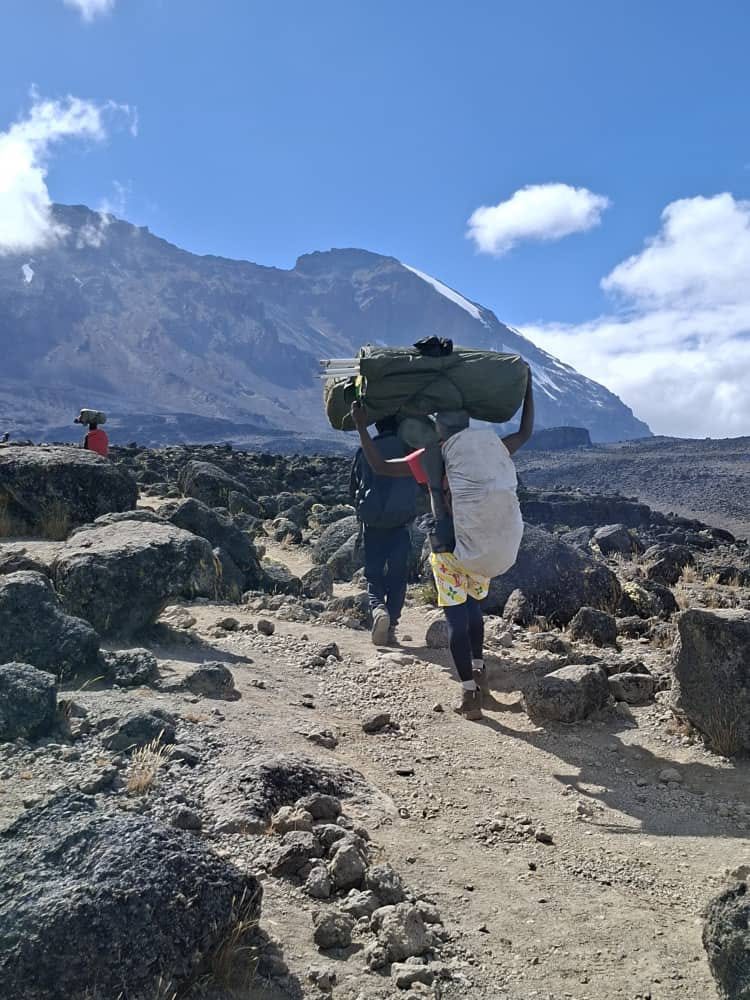
Crew wages go first. Porters carry loads to 4,600 m for people who will never know what they were paid. We pay the rates agreed at the annual meetings of the porter, cook and guide associations, and we hand tips over in front of the client at the ceremony in Moshi so nothing gets skimmed on the way. Not every company does either of those things.
Then the itinerary shortens. A 5-day climb is genuinely cheaper to sell than an 8-day climb, and it is also much harder to finish, because you have given your body three fewer days to adapt to the altitude. Cheap and short usually travel together, and the summit statistics follow them.
After that it is the things you cannot see on a website: how many assistant guides walk with eight climbers, whether there is bottled oxygen in camp, whether anyone is checking your oxygen saturation twice a day, how fresh the food is on day six. None of it shows up in the quote. All of it shows up at 5,000 m.
The practical test is simple. Ask any operator what their crew is paid, how many guides come per climber, and what medical equipment is carried. An operator who is proud of the answers will give them immediately. Our full list of questions worth asking is on the choosing an operator page.
Take the climb price for your route and group size. Add tips at $250 to $300. Add your visa at $50 or $100. Add insurance. Add flights. Add gear you do not own yet. For most people the total lands somewhere between $1,500 and $2,500 above the climb price, and flights are the part that swings hardest depending on where you fly from.
One more thing worth budgeting for, and almost nobody does: a few days after the climb. Flying home 24 hours after summit night is a miserable way to end a trip. A couple of nights in Moshi, a short safari, or a week on the coast turns an expedition into a holiday. If that appeals, read how we pair the mountain with Zanzibar.
If your budget is tight and you have to choose, spend it on days rather than luxury. An extra night on the mountain does more for your chance of standing on Uhuru Peak than any piece of equipment you can buy. The difference between a 6-day and an 8-day climb is a few hundred dollars and a large jump in the odds, which we work through in how many days you need.
Nobody comes back from Tanzania wishing they had saved $300 and turned around at 5,000 m.
No quote form, no haggling. See exactly what your route and group size costs, then talk to Nelson about dates.