Almost every climber feels something above 3,000 m. Most of it is normal and passes. A small amount of it is dangerous and needs to go down the mountain immediately. Here is how we tell the difference, and what happens next.
Most operators are vague about this. It is not good marketing to talk about people getting ill, so the subject gets a paragraph about "experienced guides" and everyone moves on.
I would rather you knew exactly what happens, because a climber who understands the warning signs tells their guide early, and early is what keeps altitude illness boring instead of serious.
Acute mountain sickness, AMS, is the ordinary version. Headache, no appetite, nausea, broken sleep, feeling wrung out. It arrives somewhere above 3,000 m and a large share of climbers get some of it. On its own it is not an emergency. It is your body telling you it has not caught up yet, and the answer is usually to slow down, drink more than you want to, eat even when you do not feel like it, and let the acclimatisation days do their work.
The two forms that matter are rarer. HAPE is fluid building in the lungs: breathlessness at rest, a wet cough, a crackling sound when breathing, lips going blue. HACE is swelling in the brain: confusion, stumbling, an inability to walk a straight line, behaviour that is simply not like the person. Either one is life-threatening within hours.
The treatment for both is the same and there is no clever alternative to it. Go down. Oxygen and medication buy time on the way, but altitude is the cause and losing altitude is the cure.
Every climber on our trips gets checked morning and evening. A pulse oximeter on the finger gives us oxygen saturation and heart rate, and we write both down so we are reading a trend across days rather than a single number. Alongside that we ask about headache, appetite, sleep and dizziness, and we watch how people are moving and talking, which often tells us more than the numbers do.
Where a climber is borderline, we use what we call the two-hour assessment. Rather than making an immediate call, we treat what we can, rest, and reassess after two hours. Some people improve quickly and carry on. Some do not, and the earlier reading has already told us which way this is going. It removes guesswork from a decision people are inclined to argue with.
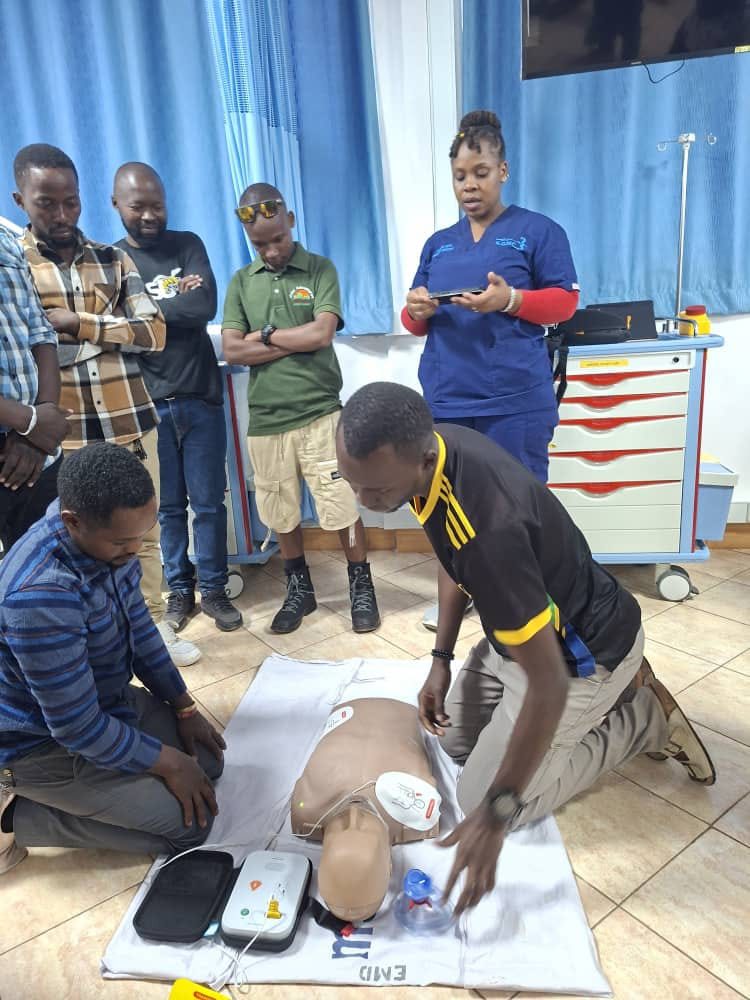
Our lead guides are certified in Wilderness First Response, and they retrain at KCMC Hospital in Moshi. The photo at the top of this page is one of those sessions.

The lead guide decides whether a climber goes higher. That is not a shared decision at 4,600 m and it is not open to negotiation, and it is the main thing you are paying a professional for.
This is worth thinking about before you book, because the moment it happens you will not want to hear it. People have saved for years, told everyone at home, and can see the summit from where they are standing. I have watched climbers with HACE symptoms insist they were fine, and the fact that they were arguing at all was part of the diagnosis. Judgement is one of the first things to go.
One climber turning back does not end the trip for everyone else. An assistant guide walks that person down while the rest continue, which is one of the practical reasons we carry more guides per group than the minimum. A cheap operator with one guide for eight climbers cannot do this, so it becomes everybody's problem.
Most descents happen on foot with a guide alongside, and by the time you have lost 500 to 1,000 m most people feel dramatically better. Where someone cannot walk, the park has stretcher trolleys and our crew carries them down to a road head.
Where it is serious, we call a helicopter. KiliMedAir operates rescue flights from altitude on Kilimanjaro, and casualties go to KCMC Hospital in Moshi, one of the best-equipped hospitals in the region and staffed by people who treat altitude illness regularly rather than occasionally.
This is a real evacuation on the mountain, filmed by one of our team.
A helicopter rescue is $3,500 without direct hospital transport, or $4,000 with transport straight to KCMC. Add hospital treatment and the total can pass $7,500.
Insured climbers do not think about these numbers, because the policy handles it. Uninsured climbers think about very little else, and worse, they sometimes hesitate over calling for help at exactly the moment hesitating is dangerous. Uninsured casualties can also wait longer for care.
So buy insurance that names high-altitude trekking to at least 6,000 m and helicopter evacuation. Ordinary travel cover excludes both, and a lot of people find that out too late. Read the wording, not the marketing page, and bring the policy number and the emergency number up the mountain with you.
Almost everything that goes wrong at altitude traces back to going up too fast. Take the longer itinerary. The extra nights on an 8-day route are the reason its summit rate beats a 5-day route, and they are the cheapest safety equipment you can buy. We work through the trade-off in how many days you need.
Then walk slowly enough to feel silly. Drink far more water than you think you need. Eat at every meal even when the appetite has gone, because the fuel matters. And tell your guide the moment something feels wrong, rather than at the end of the day when you have already walked six hours on it. Nobody has ever been sent home for reporting a headache.
Our full protocols, evacuation points by route and insurance requirements are on the safety and rescue page. If you are still comparing operators, the questions on the choosing an operator page are the ones worth asking about all of this.
Every climb carries oxygen, a pulse oximeter and WFR-certified guides, and every climber gets checked twice a day. Ask Nelson anything about how we run it.