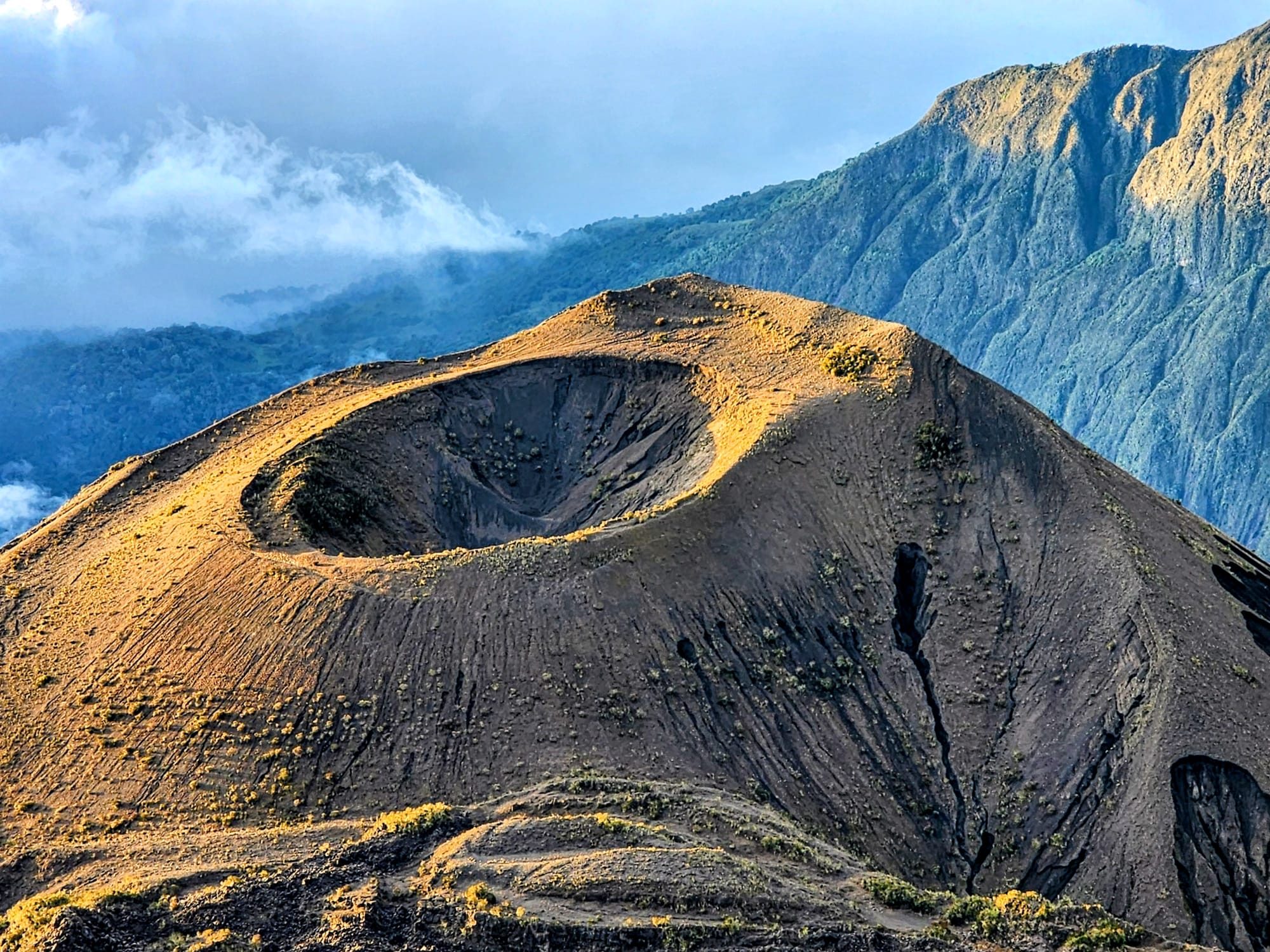
They sit 70 kilometres apart and could hardly be more different. One is the highest mountain in Africa. The other is steeper, wilder, full of animals, and the best possible warm-up for it. Here is the honest comparison from a team that guides both.
Almost everyone who lands at Kilimanjaro International Airport is looking at one mountain. But there is a second one out of the window on the drive to Moshi, and plenty of climbers who take it on tell us afterwards that it was the better trek of the two.
This is not a piece designed to talk you out of Kilimanjaro. Uhuru Peak is the reason most people come to Tanzania and it deserves its reputation. But Mount Meru is badly underrated, and if you have the days, climbing it first is the single most effective thing you can do to improve your odds on the big mountain.
| Mount Meru | Kilimanjaro | |
|---|---|---|
| Summit | Socialist Peak, 4,566 m | Uhuru Peak, 5,895 m |
| Days on the mountain | 3 or 4 | 5 to 9 |
| Routes | One, the Momella Route | Seven main routes |
| Where you sleep | Wooden huts, no tent needed | Tents, except the Marangu huts |
| Armed ranger | Required, wildlife on the trail | Not required |
| Summit day | 12 to 15 hours | Roughly 12 to 16 hours up and down |
| The real challenge | Steep, exposed crater ridge | Altitude |
| From, per person | $1,100 | $1,470 |
This is the question we get most, and the honest answer is that they are hard in completely different ways.
Kilimanjaro is harder overall, and the reason is altitude. At 5,895 m the air holds roughly half the oxygen your body is built for. Nothing about the walking is technical. What breaks people is the thin air, the cold, and the cumulative fatigue of a long summit night that starts around midnight. Success on Kilimanjaro is mostly a question of how many days you gave your body to adapt.
Mount Meru is harder day for day. Plenty of experienced hikers finish Meru and say the summit day was tougher than anything on Kilimanjaro. The trail is steeper, and the last stretch to Socialist Peak follows a narrow crater ridge with serious drop-offs on both sides, walked in the dark by headlamp with some easy but unsecured scrambling near Rhino Point. No ropes or technical gear are needed, but you do need a head for heights and steady footing when you are tired.
Put simply: Kilimanjaro tests your patience and your lungs. Meru tests your legs and your nerve.

This is the strongest argument for climbing both, and it is a physiological one rather than a sales pitch. The two peaks are only 70 kilometres apart, so you can climb one and be at the gate of the other inside a couple of hours.
Climbing Meru takes your body to 4,566 m and holds it at altitude for several days. Your system responds by producing more red blood cells and adapting its breathing. Arrive at Kilimanjaro a few days later and you are not starting from sea level, you are starting from a body that has already done the work. In our experience that shows up directly in how climbers cope on the upper mountain, and it is the closest thing to an insurance policy against altitude sickness that we can offer.
There is a confidence effect too, and it matters more than people expect. Standing on a summit at 4,566 m after a genuinely demanding night changes how you approach Kilimanjaro's summit push. You already know what your body does when it is cold, dark and hard.
Mount Meru sits inside Arusha National Park, which is a live wildlife area. That is why an armed park ranger is required to walk with every trekking group, and it turns the first day into something Kilimanjaro simply does not have.
You walk up through open savannah and tropical forest with buffalo, giraffe, zebra and warthog around you, dik-dik and Harvey's red duiker in the undergrowth, and black-and-white colobus and blue monkeys overhead. Elephant and leopard are present, though rarely seen. If you are already planning a safari, Meru gives you a day of it on foot rather than through a vehicle window.
On Meru you sleep in permanent wooden mountain huts at Miriakamba (2,514 m) and Saddle Hut (3,560 m). Bunk rooms, communal bathrooms, mess halls, and no tent to carry or pitch. A warm sleeping bag is still essential, because Saddle Hut is cold at night.
On Kilimanjaro, only the Marangu route uses huts. Every other route is a camping trip, with our crew carrying, pitching and striking the tents each day. Neither is better, but if the idea of five nights under canvas is what is holding you back, Meru is worth a look.
Meru has one official trail, the Momella Route, and two ways to walk it.
The four-day climb is the one we recommend. It splits the ascent into two comfortable days, gives you the optional acclimatisation hike up Little Meru (3,820 m) on the afternoon of day two, and leaves an easy walk out on the final morning. If you are using Meru to prepare for Kilimanjaro, the extra night is exactly the point.
The three-day climb compresses that first section into a single 17 km push straight to Saddle Hut. It works for fit, well-acclimatised trekkers who are short on time, but it is a hard way to see a beautiful mountain and it gives your body less to work with. Full day-by-day breakdowns for both are on the Mount Meru climb page.
If you want the pair, the order is not negotiable: Meru first, Kilimanjaro second. Doing it the other way round wastes the acclimatisation entirely.
Budget 12 to 16 days on the ground once you add travel at each end. If that sounds like a lot, it is worth remembering that the most common reason climbers fail on Kilimanjaro is trying to do it in too few days.
Climb Kilimanjaro if this is a once-in-a-lifetime trip, the summit itself is the goal, and you have between 7 and 12 days. It is the highest mountain in Africa and the highest free-standing mountain in the world, and no other trek carries the same weight when you get home.
Climb Mount Meru if you want a quieter mountain, you like the idea of wildlife on the trail and huts at night, you are an experienced hiker who wants a trek with more character than crowds, or you are on a tighter budget or a shorter schedule.
Climb both if you have two weeks and you want the best possible chance at Uhuru Peak. This is what we suggest to anyone who asks how to improve their odds, and it is more effective than any amount of extra training at home.
Both mountains share the same seasons. June to October is the main window: cool, stable and dry. December to February is the second window, warmer with clearer skies, and on Meru it gives the best odds of a summit sunrise with Kilimanjaro on the horizon. Avoid the long rains of April and May and the short rains in November, when Meru's steep trails turn slippery and genuinely dangerous. There is more on timing in our guide to the best month to climb Kilimanjaro.
Mount Meru is priced per person by group size. The recommended four-day climb runs from $1,450 for a solo climber down to $1,140 per person in a group of five. The three-day runs from $1,340 down to $1,100, and groups of six or more get a discount. That covers guides, the armed ranger, all Arusha National Park fees, huts, meals, oxygen and first aid, crew wages, and transfers to and from Momella Gate.
Kilimanjaro starts at $1,470 per person for a 5-day Marangu climb in a group of eight and runs up to $3,510 for a solo climber on the 9-day Northern Circuit. Full transparent tables for every route and group size are on the climb prices page.
If you are weighing up which Kilimanjaro route suits you once you have decided, compare the routes side by side or read our breakdown of Lemosho vs Machame.
Tell Nelson your dates and how many days you have, and he will build the combination that gives you the best chance at the summit.