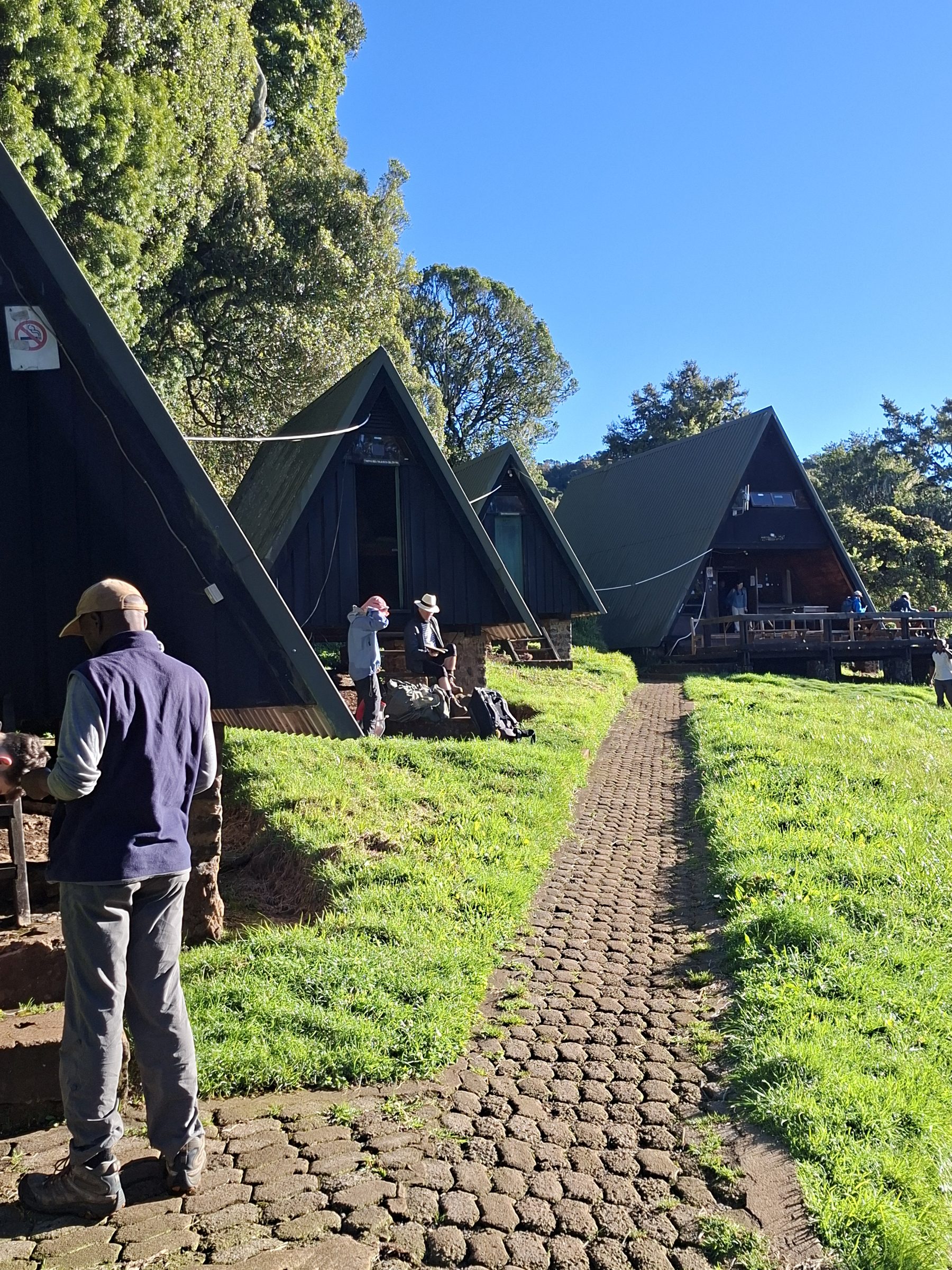
Every other way up Kilimanjaro is a camping trip. Marangu gives you a bunk, a roof and a dining hall. That trade is worth understanding properly, because the route's easy reputation is the most misleading thing about it.
Marangu is the oldest path up this mountain and the only one with permanent buildings on it. For a lot of climbers that single fact decides the trip. The idea of six nights under canvas at altitude is enough to put some people off Kilimanjaro entirely, and Marangu is the answer to that.
It is also the route I am most careful about recommending, and the reasons have nothing to do with comfort.
Three sets of huts sit on the route. Mandara at 2,720 m after your first day through the forest, Horombo at 3,720 m where you spend two nights on the six-day version, and Kibo below the summit where nobody sleeps much anyway.
Mandara and Horombo are clusters of green-roofed A-frames, wooden, simple, built to last. Inside are bunk beds in shared rooms, usually four to a room, with a mattress and a pillow. There is a communal dining hall where meals are served and where everyone ends up talking in the evening, and shared bathrooms with running water at the lower huts.

You still need a proper sleeping bag. The huts are unheated and Horombo at 3,720 m gets genuinely cold once the sun goes. What you do not need is a tent, a sleeping mat, or the willingness to crawl out into the rain at two in the morning.
There are also a small number of self-contained cabins, which have their own room and door rather than a shared dormitory. They are limited and they book out, so ask early if that matters to you.

Marangu picked up the name because it was the established tourist route with huts, a graded path and, at the lower huts, drinks for sale. Machame got called the Whiskey route by comparison: rougher, steeper, tents.
The problem is that people hear Coca-Cola and read it as easy, then book the shortest version and are surprised when the mountain does what the mountain does. Marangu has one of the lower summit success rates on Kilimanjaro. Not because the walking is hard, but because of how the route is usually sold.
The first is the profile. Marangu goes up and comes back down by the same path, which sounds convenient and costs you the climb-high-sleep-low days that Machame and Lemosho build in naturally. Your acclimatisation is a straight line up, which is the pattern most likely to make you ill. Our post on how many days to take goes into why that matters so much.
The second is that it is normally sold as five days, because it is the cheapest climb on the mountain and the price is the selling point. Five days is not enough time for most bodies. Take the six-day version, spend the extra night at Horombo, and use that day to walk up toward the Zebra Rocks and come back down to sleep. That single addition does more for your odds than anything else available on this route.
There is a scenery cost too. Because you return the way you came, you see the same ground twice, and you miss the Barranco Wall, the Shira Plateau and the Lava Tower that make the southern routes what they are.

The forest on day one is the best on the mountain. Thick, mossy, dripping, full of birdsong and colobus monkeys, and you walk through it on a well-made path rather than a mud slide.
In the wet season the huts move from a preference to a genuine advantage. Sleeping dry after a day of rain, with somewhere to hang wet clothing and a hall to eat in, is worth a great deal. It is the route I suggest to people who insist on climbing in April or November, which I have written about in climbing in the rainy season.
It is also sociable in a way camping is not. Everyone eats in the same hall, and by the second night you know the Germans, the retired couple from Ontario and the group of students. And it is the cheapest way up, starting at $1,470 per person in a group of eight, which for some people is the difference between climbing this mountain and not.
Take Marangu if sleeping in a tent is genuinely the thing standing between you and this mountain, if you are climbing in the wet months, or if budget is the deciding factor. Take the six-day version when you do.
Choose something else if your priority is standing on Uhuru Peak or seeing the best of the mountain. Machame over seven or eight days, Lemosho, or the Northern Circuit will all give you better odds and far better scenery, and the comparison is laid out on the route comparison page.
One thing worth saying plainly: there is no shame in wanting a bed. Plenty of people summit from Marangu every season. Just go in understanding what the huts cost you as well as what they give you.
Tell Nelson what matters most to you and he will be straight about which route fits, including when Marangu is the wrong answer.