
The glaciers on Mount Kilimanjaro are one of the great natural wonders of equatorial Africa, and one of the world's clearest visual indicators of climate change. The ice that gave Kilimanjaro its iconic snow-capped silhouette has shrunk by more than 90 percent in the last 110 years, and the rate of loss is accelerating.
This post covers what remains of the glaciers, the named ice fields you can still see, the science of why they are vanishing, and how to see them as part of your climb.
The scale of the loss
In 1912, the first systematic measurements showed Kilimanjaro covered by approximately 11 square kilometres of ice. The summit and the upper crater were heavily glaciated. Photographs from the early 20th century show vast continuous ice fields covering most of the upper mountain.
Today, less than 1 square kilometre of ice remains. The Northern Ice Field, once a continuous block, has fragmented into separate entities. The Furtwangler Glacier in the summit crater has thinned dramatically. Smaller glaciers have disappeared entirely.
Scientists studying the mountain estimate that the remaining ice could be largely gone within decades. The current generation of Kilimanjaro climbers is the last to see the mountain's glaciers as a meaningful presence.
The glaciers that remain
Five named glaciers and ice fields still exist on Kilimanjaro in some form:
Furtwangler Glacier
The most accessible of the remaining glaciers. Located in the summit crater near the highest point. Climbers who descend briefly into the crater after Uhuru Peak see Furtwangler up close. It has thinned dramatically over the last century. Once a substantial block of ice, today it is a smaller frozen mass that scientists watch closely.
Northern Ice Field
The largest remaining glacier on the mountain. It once formed a continuous ice sheet across the northern part of the summit. Today it has split into separate entities, with bare rock exposed between sections that were continuous within living memory. The best viewpoint of the Northern Ice Field requires about two hours of additional hiking from Uhuru Peak, which we generally do not recommend due to summit fatigue.
Heim Glacier (effectively gone)
Once a famous destination for glacier climbing on Kilimanjaro. Diminished and effectively disappeared as a substantial ice mass around 1996. The area where it stood remains spectacular and is the location of our post-summit glacier viewpoint tour. From the Heim location climbers see remnants of multiple smaller ice features and the surrounding crater landscape.
Southern Glaciers
The ice features on the southern face of Kibo, visible from Lava Tower and Arrow Glacier viewpoints. Photogenic against the dark volcanic rock. Significantly diminished from historic extent.
Smaller named glaciers
Several smaller named features (Arrow Glacier, Decken Glacier, others) have either disappeared or are reduced to small remnants. The named glacier on a 1950s map of Kilimanjaro is often no longer there in 2026.
Why they are vanishing
The simple answer is climate change. The more specific answer involves three combined factors:
- Rising global temperatures. The equatorial troposphere has warmed measurably, increasing the rate of ice loss.
- Reduced snowfall. The pattern of precipitation on Kilimanjaro has shifted. Less snow falls at altitude than 100 years ago.
- Sublimation. A process specific to high-altitude tropical glaciers. The ice does not melt to liquid water and run off. It evaporates directly to vapour. The intense equatorial sun at altitude drives this process even when temperatures are below freezing.
Sublimation is the key reason Kilimanjaro's glaciers are vanishing despite the summit remaining below freezing. The ice is not melting in the conventional sense. It is gradually disappearing into vapour, faster than new snowfall can replace it.
The UNESCO World Heritage status
Kilimanjaro National Park is a UNESCO World Heritage Site, and the glaciers are specifically recognised as climate archives. The ice cores extracted from the glaciers over the last decades have provided scientists with detailed records of atmospheric conditions stretching back thousands of years. When the glaciers vanish, that scientific record is lost.
UNESCO has identified Kilimanjaro's glaciers as among the world's most threatened World Heritage features. The pace of loss has accelerated over the last 20 years.
How to see them on your climb
The remaining glaciers are visible to every climber who summits Uhuru Peak. From the summit:
- Furtwangler Glacier: visible looking into the crater.
- Northern Ice Field: visible looking north from the rim.
- Southern Glaciers: visible looking south.
- Heim area: a brief descent to the viewpoint is part of our optional post-summit glacier tour.
The recommended view is the Heim area, accessible via a short descent from the crater rim. Reaching the Northern Ice Field's best viewpoint requires two extra hours and is generally not recommended due to fatigue at altitude.
Standing at the ice
The experience of standing beside the remaining glaciers is unlike anything else on the climb. The ice walls are massive and white against the dark volcanic rock. You can hear the wind in the ice channels. You can see the layered structure of the ice from decades of compressed snow. You are looking at frozen history.
Standing beside the icefields felt like touching a piece of ancient Earth. Beautiful, massive, and disappearing. I'll never forget it.
Many climbers describe the glacier moment as more emotionally affecting than the summit moment. The summit is achievement. The glaciers are loss made visible.
The bottom line
Kilimanjaro's glaciers have shrunk by over 90 percent in 110 years and continue to retreat. The Northern Ice Field, Furtwangler Glacier, Southern Glaciers, and the Heim area are the major remaining features. Climbers who summit Uhuru Peak see them all from the rim. The optional post-summit glacier viewpoint tour brings you closest to the ice itself.
If seeing the glaciers matters to you, climb sooner rather than later. The current decade is likely the last in which Kilimanjaro's glaciers will be a substantial presence on the mountain. Read our Glacier Tour page for the post-summit experience.
Frequently asked questions
Can I touch the glaciers on Kilimanjaro?
Yes, in the areas accessible from the crater rim. You can stand right beside the ice walls and (carefully) touch them. The team carries microspikes or crampons in case ice conditions require them.
Will the glaciers be gone by 2050?
Scientific projections suggest most of the remaining ice could be gone within two to three decades, with uncertainty depending on climate trajectory. Some smaller features may persist longer in protected microclimates within the crater.
Is the glacier tour included in my climb?
It's an optional post-summit add-on, not included by default. Discuss with Nelson at booking. See the <a href='../glacier-tour.html'>Glacier Tour page</a> for details.
Related posts
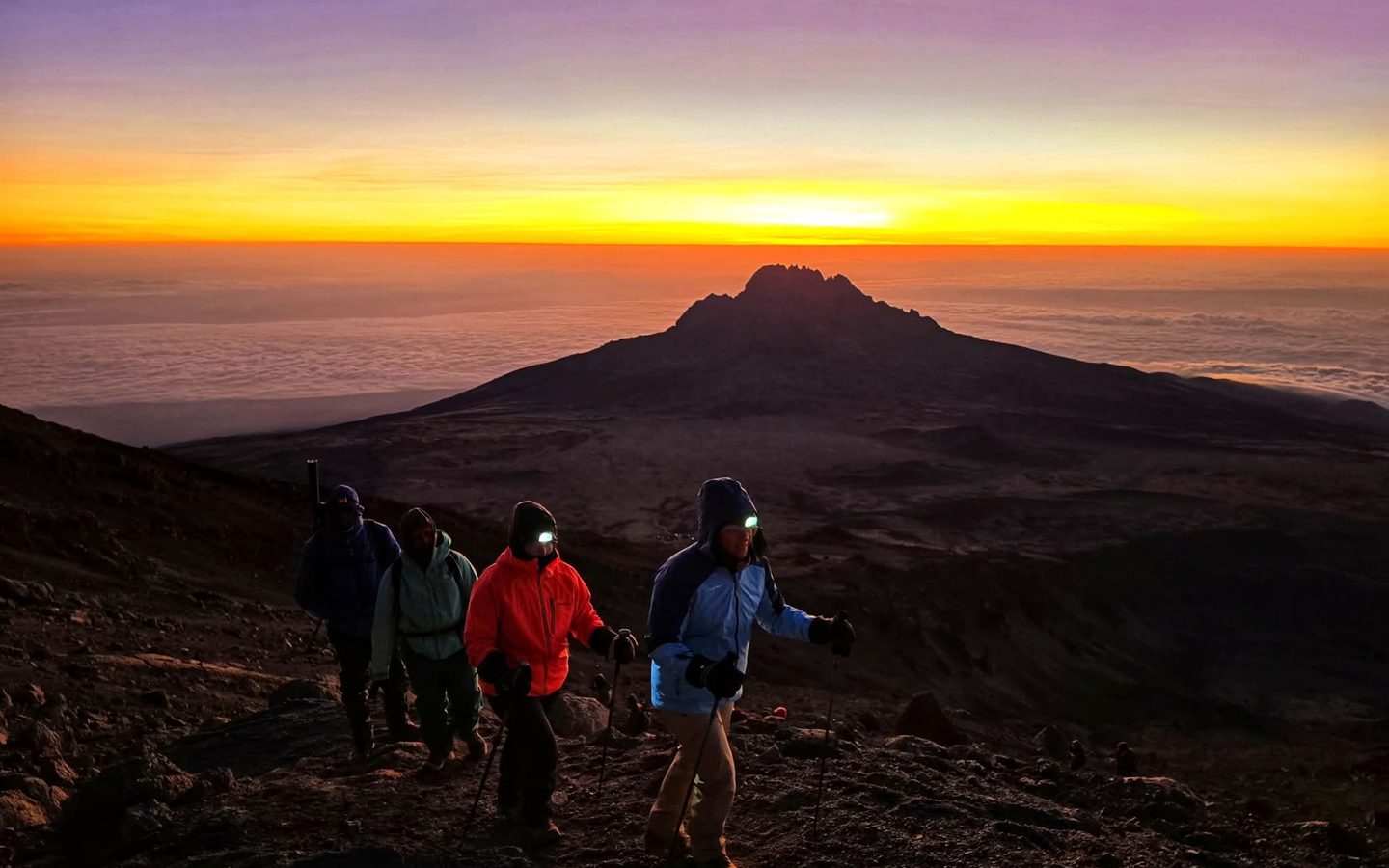
What Summit Night on Kilimanjaro Actually Feels Like
Eleven PM wake-up. Eight hours of cold dark ascent. Sunrise on the crater rim. The honest hour-by-hour account.
How Cold Does Kilimanjaro Actually Get?
Tropical heat at the gate, -20 C at the summit. Five distinct climate zones, each with its own dress code. Here is what to expect by altitude.
Karanga to Barafu: The Shortcut Nelson Pioneered on Kilimanjaro
Nelson helped pioneer a navigational refinement on the Southern Circuit that's now used by guides across the mountain. The story behind the route.