Kilimanjaro Glacier Tour.
An optional post-summit experience for climbers who reach Uhuru Peak: a short, guided descent to the Heim Glacier viewpoints, where ancient ice walls and the crater landscape are still close enough to touch. A rare privilege, and one that may not exist for much longer.
A Brief Detour Into Kilimanjaro's Ice History
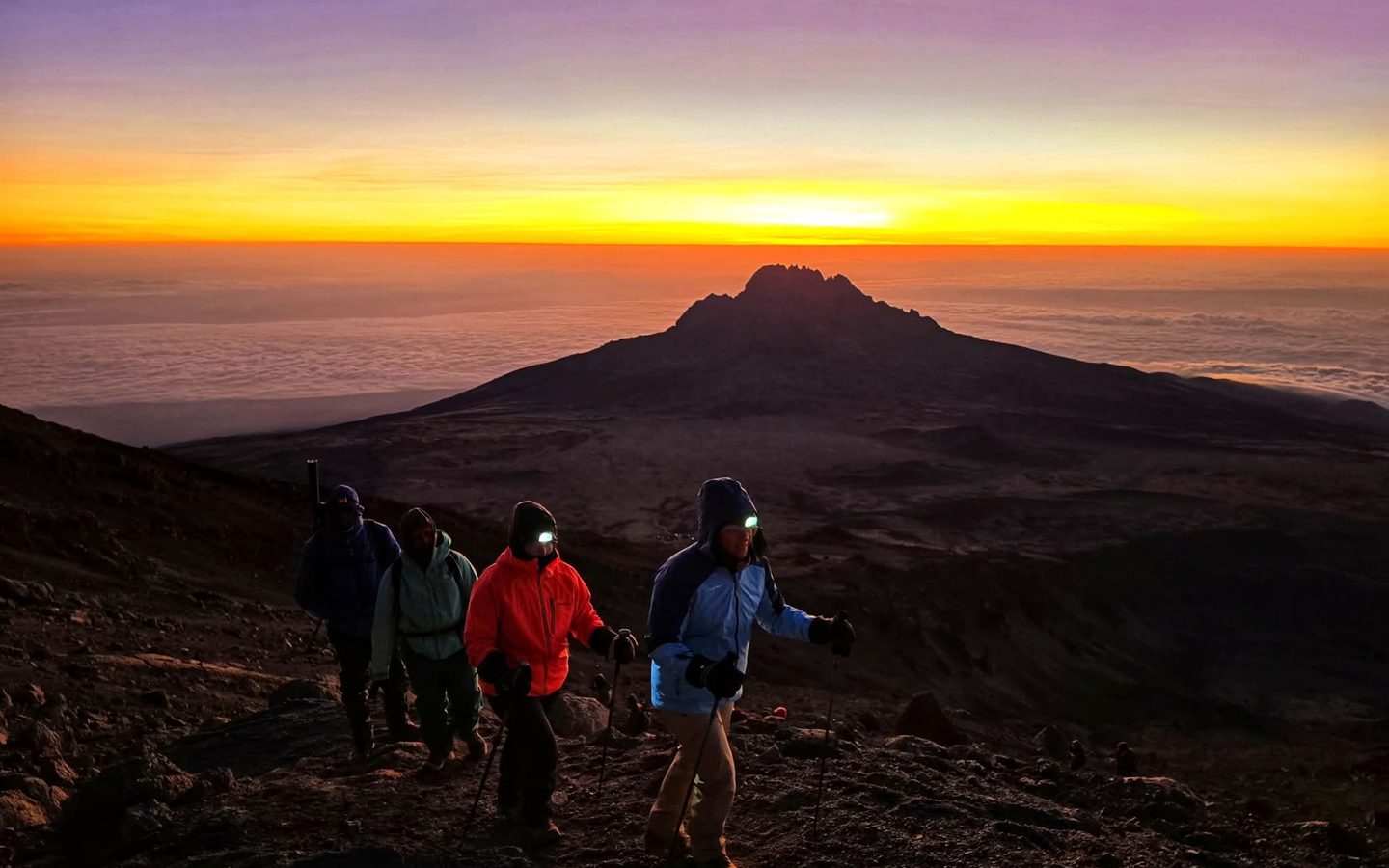
For climbers who reach Uhuru Peak (5,895 m), the glacier tour is an optional add-on built into your descent. Once you have rested at the summit, drunk water, eaten food, and received clearance from your guide, the tour leads you into the crater area to viewpoints near the Heim Glacier. From these positions you see the massive white walls, ice towers, and surreal ice formations that remain on the mountain.
It is a slight descent from Uhuru, around 230 m down, on a mixture of rocky volcanic ash, scree, and patches of snow and ice. The full experience typically takes one to two hours from Uhuru Peak, depending on pace and the specific viewpoints visited. You are not climbing more; you are using your descent to see something most people never do.
Why We Recommend Heim Glacier, Not the Northern Ice Field
The Northern Ice Field is the largest remaining glacier on Kilimanjaro. The best viewpoint requires roughly two extra hours of hiking from Uhuru. Climbers are already exhausted from the summit push and at extreme altitude where every minute drains oxygen reserves. We strongly recommend the Heim Glacier area instead: it is accessible via a brief descent from the crater rim, takes only a few minutes of hiking, and lets you experience the majesty of the glaciers without the additional energy expenditure that would compromise your safety or your recovery.
The Heim Glacier itself is no longer present as a substantial ice mass. It diminished and effectively disappeared around 1996. What remains in that area is still spectacular: surrounding ice formations, the surreal architecture of the Furtwangler Glacier nearby, and the fragmented remnants of what used to be the Northern Ice Field. You see the beauty and the loss in the same moment.
Equipment by Ice Condition
Whether you need microspikes or crampons depends entirely on the current conditions, which your guide assesses on the day. A critical advantage of the early-morning glacier tour is that the sun's rays provide natural warmth, which significantly reduces the risk of frostbite during your time on the ice.
| Condition | Required Footwear and Traction | Guide Action |
|---|---|---|
| Clear trails, packed snow | Insulated hiking boots rated for -30 C | Proceed with standard caution. |
| Light ice patches | Insulated boots plus trekking poles for stability | Navigate around slick areas. |
| Heavy ice, frozen trails | Insulated boots plus microspikes or crampons | Guide assists with gear attachment. |
| Severe weather or whiteout | Full winter gear | Abort glacier tour, begin main descent immediately. |
Your guide makes the final determination based on real-time assessment. The team carries the full traction kit; you do not need to source microspikes or crampons separately.
A Vanishing Wonder
The glaciers of Mount Kilimanjaro are designated UNESCO World Heritage glaciers. They serve as crucial climate archives, storing ancient atmospheric data that scientists use to understand Earth's past. They are retreating at an alarming rate due to rising global temperatures, reduced snowfall, and sublimation (the process by which ice evaporates directly into vapour).
In 1912 the mountain was covered by approximately 11 square kilometres of ice. Today, less than 1 square kilometre remains. When you visit the glacier areas near the Heim location, you observe massive white walls and gleaming ice towers alongside fragmented, retreating remnants. The Northern Ice Field, once a continuous block, has split into separate entities. The Furtwangler Glacier has thinned significantly.
This is a window of years, not decades. Visiting the glaciers now is a rare privilege to witness ancient natural history before it vanishes. For climbers who care about the mountain's story, this is the chapter you cannot read in a book.
Safety Comes Before the Photo
The glacier tour is an add-on, not a default. We only run it when conditions allow and only for climbers whose condition allows. Here is the protocol your guide follows:
- After you reach Uhuru Peak, you rest 20 to 30 minutes. The guide monitors your blood oxygen with a pulse oximeter and watches for signs of acute mountain sickness.
- You hydrate, ideally with electrolyte mix, and consume high-calorie snacks and hot beverages. Body temperature must stay constant, otherwise the body burns energy heating or cooling itself.
- The guide makes the call: if your condition is borderline, the glacier tour is skipped and we begin the main descent immediately. If you are stable, we proceed.
- The guide assesses ice conditions and decides on traction gear in real time.
- We do not linger. The tour is brief by design, then we descend to thicker air where your body can recover.
See our full safety and rescue protocols for how we approach every climb.
Glacier Tour FAQ
What is the post-summit glacier tour?
It's an optional add-on for climbers who have reached Uhuru Peak. After resting at the summit, your guide leads a short descent into the crater area to viewpoints near the Heim Glacier location, where you can stand close to ancient ice walls, gleaming ice towers, and the remnants of Kilimanjaro's glaciers. The full experience including descent and viewing typically takes one to two hours from Uhuru Peak.
Why do you recommend Heim Glacier rather than the Northern Ice Field?
The Northern Ice Field is the largest remaining glacier on Kilimanjaro, but reaching its best viewpoint takes approximately two hours of additional hiking from Uhuru Peak. Climbers are already exhausted from the summit push and at extreme altitude. The Heim Glacier area sits just a brief descent below the crater rim, requires only a few minutes of hiking to reach excellent viewpoints, and lets you experience the majesty of Kilimanjaro's glaciers without compromising your safety or your recovery.
Is the Heim Glacier still there?
The Heim Glacier itself was once a famous destination for glacier climbing on Kilimanjaro but it diminished and effectively disappeared around 1996. What you visit today is the area where it stood, which still offers spectacular views of the remaining ice formations and the surrounding crater landscape. You see massive white walls, ice towers, and surreal formations alongside the visible reality that the ice is fragmenting and retreating. The Northern Ice Field, once a continuous block, has split into separate entities, and the Furtwangler Glacier has thinned significantly.
Do I need crampons or microspikes for the glacier tour?
It depends entirely on current conditions, which your guide assesses on the day. Under clear conditions with thick stable ice and packed snow, high-quality insulated hiking boots are sufficient. If trails are free of thick slippery ice, you can safely approach the glaciers without microspikes. If the mountain has recently experienced heavy snowfall or if trails have frozen over into slick ice sheets, traction devices are required. We carry microspikes and crampons in the team kit and the guide makes the call in real time.
What is the temperature like at the glacier?
The summit temperatures range from 0 C down to a bone-chilling -30 C, with wind speeds sometimes over 50 km/h. The glacier tour happens shortly after summit, so you are still in that range. The advantage of doing it in the early morning is that the sun's rays provide natural warmth, significantly reducing the risk of frostbite during your time on the ice.
How does Go Kilimanjaro Treks make this safe?
Three things. First, we only run the glacier tour after you have rested, hydrated, and received explicit clearance from your guide. The guides use pulse oximeters to check your blood oxygen and watch for any signs of acute mountain sickness. Second, we carry full traction gear in the team kit and the guide assesses the current ice conditions in real time. Third, the guide has absolute authority to abort the tour if weather deteriorates or if your condition is borderline. Safety comes before the photo.
Is the glacier tour included in my climb price?
It is an optional add-on. Pricing depends on the route, the size of your group, and the season. Talk to Nelson at the time of booking to add it to your itinerary.
Will the glaciers still be there in ten years?
Probably not in the form they are today. The glaciers of Kilimanjaro are UNESCO World Heritage glaciers serving as crucial climate archives that store ancient atmospheric data. They are retreating at an alarming rate due to rising global temperatures, reduced snowfall, and sublimation, where ice evaporates directly into vapour. In 1912 the mountain was covered by approximately 11 square kilometres of ice. Today, less than 1 square kilometre remains. Visiting the glaciers now is a rare privilege to witness ancient natural history before it vanishes.
Who should NOT do the glacier tour?
Anyone showing signs of altitude sickness, severe exhaustion, or who is borderline on oxygen saturation should descend immediately rather than detour to the glaciers. Your guide will make this call honestly. The summit is the achievement. The glaciers are a bonus only if your body can absorb the extra exposure.
What gear do I bring for the glacier tour?
Everything you wear for summit night plus a few specifics. The full layering system (moisture-wicking base, heavy insulation, windproof and waterproof shell) is mandatory. Insulated gloves with liner gloves underneath, a warm hat, a balaclava or neck gaiter, and thick wool or synthetic socks all matter. UV protection at nearly 6,000 m is non-negotiable: UV-protective sunglasses and SPF 50+ sunscreen, even on cloudy days, because UV radiation at altitude is 60 percent higher than at sea level. The team provides traction gear (microspikes or crampons) when conditions require them.
Add the Glacier Tour to Your Climb.
Talk to Nelson about route options, your fitness profile, and whether the glacier add-on is right for your itinerary.